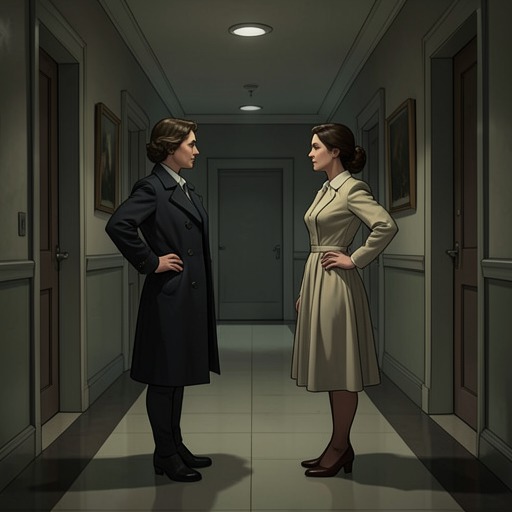
Andrea and Vittoria’s sibling relationship
The Lying Life of AdultsAndrea and Vittoria’s sibling relationship is a prolonged estrangement in which family loyalty becomes a struggle over who may define the past. To Giovanna, their daughter and niece, the conflict arrives first as a warning: her father presents Vittoria as a danger to his bond with his child, while Vittoria later recounts events that make his conduct look damaging to her and to Enzo’s family. Years later, Giovanna helps reopen a channel between them, but Andrea insists that the passage of time and her intervention have not made peace possible.
A rupture inherited by Giovanna
When Giovanna is twelve, she overhears Andrea tell her mother that adolescence is not the reason for her disappointing schoolwork: she is beginning to look like Vittoria. The remark turns a judgment about appearance into an entrance to a deeper family hostility. Andrea and his wife have long treated Vittoria as the embodiment of ugliness and spite, and his comment leaves Giovanna to understand that resemblance to her aunt is feared as a resemblance in character as well as face.
Andrea’s account, relayed to Giovanna, presents him as a brother whose attempts at help have repeatedly been rejected. He says that he reasoned with Vittoria, encouraged her, and gave her as much money as he could, but that she interpreted his words as bullying and his assistance as an injury. He describes her as proud, ungrateful, and cruel, and says she has used family members to wound him. His fear is not simply that Giovanna will meet her aunt: he believes Vittoria will try to take the child’s affection away from him, as she has supposedly turned their parents, siblings, aunts, uncles, and cousins against him.
The conflict is set against the very different childhoods Andrea and his wife describe. They say they made sacrifices to become what they are, but portray Andrea’s early life as especially hard: he had nothing and had to climb toward security through sustained effort. In that account, Vittoria is the storm that repeatedly threatens to force him back to the beginning. The metaphor makes their estrangement part of Andrea’s self-understanding: his struggle upward and his sister’s hostility are presented as inseparable.
Help, resentment, and the disputed past
Andrea’s wife gives Giovanna a specific explanation for the breach. Vittoria left school in the fifth grade and works as a maid; according to her, Vittoria blames Andrea for her position. She also says that Andrea intervened when Vittoria was in love with a married criminal who already had three children, believing that his sister was in danger of ruining her life. In the wife’s telling, Andrea acted to save Vittoria, but Vittoria added that intervention to the grievances she would never forgive. The same act can therefore appear as protective responsibility to one side and unwanted interference to the other.
Vittoria’s account of a later family dispute further complicates Andrea’s version. The parents’ house was the only property left to their five children. Andrea, she says, insisted that it belonged to all five and should be sold, with the proceeds divided; Vittoria argued that she had put her own money into helping their parents and had nowhere else to turn, while the other siblings supported leaving the house to her. The disagreement lasted for months, with Andrea on one side and Vittoria and the other three siblings on the other.
Enzo, Andrea’s friend and Vittoria’s lover, intervened on Vittoria’s behalf, offering to pay Andrea’s share himself. Vittoria says Andrea rejected his involvement and insulted his standing and means. The quarrel escalated until Enzo threatened to shoot Andrea, after which Andrea left. Vittoria then says Andrea went to Enzo’s wife, Margherita, and disclosed the affair in front of their three children. She sees this disclosure as an act that damaged the lives of herself, Enzo, Margherita, and the children. Her narrative directly challenges the image of Andrea as a brother whose interventions were simply benevolent, though Giovanna remains uncertain and cannot readily reconcile the allegation with her father’s own principles.
Estrangement as a family system
The two accounts do not settle into a shared explanation. Andrea’s wife says reconciliation is impossible because, in Vittoria’s eyes, Andrea would have to become mediocre like the men she knows. She adds that Vittoria set the family against them, leaving Andrea and his wife without a real relationship with the relatives after the grandparents died. Andrea likewise presents the estrangement as encompassing the wider family, but attributes that isolation to Vittoria’s deliberate influence. Each account makes the sibling dispute the cause of a broader division, while locating responsibility in the other person.
Giovanna is drawn into this division as a listener and potential intermediary. Andrea begs her not to listen to Vittoria and urges her to protect herself from her aunt’s influence. Yet Giovanna’s contact with Vittoria gives her access to memories and claims that her parents had kept from her. Her knowledge of the adults’ conflict also intersects with her suspicions about her mother and Mariano: she considers telling Vittoria what she has observed, but decides against it because she fears her aunt would use the information to condemn her mother and thereby wound Andrea. In this way, the sibling rupture shapes what Giovanna can say, whom she can trust, and how she weighs loyalty against what she has seen.
Resemblance, mediation, and an unfinished opening
Giovanna eventually recognizes that neither Andrea nor Vittoria can escape their shared roots. She observes that all three may end up loving or hating themselves, depending on the circumstances, because each carries something of the same family inheritance. That recognition complicates the original warning that becoming like Vittoria is a threat: resemblance is not only a weapon in the siblings’ conflict but also a sign that their bond survives the estrangement.
Much later, Andrea tells Giovanna that Vittoria has identified a woman who could help care for a friend of Costanza’s, and that Vittoria herself has come to visit. He immediately refuses Giovanna’s conclusion that this means they have made peace: peace with Vittoria, he says, is impossible. But he credits Giovanna with having acted slowly and shrewdly as a bridge between them, calls her clever and like himself, and acknowledges the practical connection she has helped create. The relationship therefore ends in neither reconciliation nor complete separation. Their shared family roots remain emotionally charged, while Giovanna’s mediation makes renewed contact possible without erasing the history that keeps the siblings apart.